










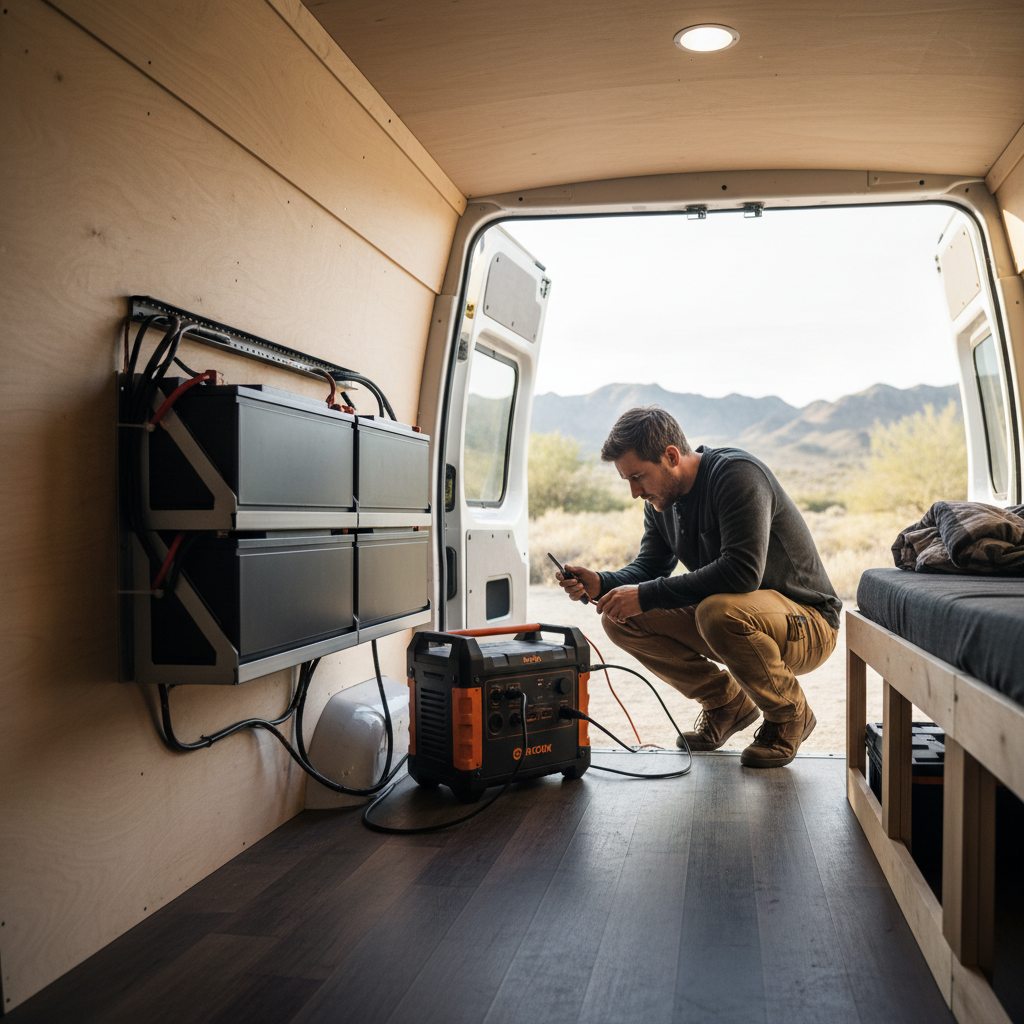
Van converters who skip this decision early end up making it twice, usually after spending money they can't recover. The choice between a portable power station and a built-in van battery system shapes everything downstream: where you mount your fridge, how you charge your devices, whether you can add solar later without rewiring half the vehicle.
Two variables most comparison guides leave out are continuous discharge rate and thermal management. A portable unit rated at 2,000 Wh looks equivalent to a built-in 200Ah lithium bank on paper, but those numbers describe capacity, not behavior under load. How the power is delivered, sustained, and protected at temperature extremes is where the real differences live.
Your van's intended use pattern is the governing factor here, and it's more specific than just "weekend trips vs. full-time living." The tension worth sitting with before you buy anything: the system that's cheaper and faster to set up often costs more per year of actual use, while the system that demands a $1,500+ upfront installation can pay for itself inside 18 months if your usage profile justifies it. Neither claim is always true, and figuring out which applies to you is the actual work this article does.
What Each System Actually Does Under Real Conditions
A portable power station is a self-contained unit: battery cells, BMS (battery management system), inverter, charge controller, and output ports in one enclosure. Brands like Jackery, EcoFlow, and Bluetti dominate the US market, with capacities ranging from around 500 Wh for weekend-trip units up to roughly 4,000 Wh for their largest models. You plug it in at home, carry it to the van, and run devices off its output ports. Setup time is measured in minutes.
A built-in system is a custom electrical install: one or more lithium (LiFePO4) or AGM batteries wired to a DC-DC charger that pulls from the alternator, a solar charge controller if you're adding panels, a battery management system, bus bars, fusing, and an inverter if you need 120V AC output. The components are sourced separately and installed permanently. Typical DIY materials cost for a functional 200Ah LiFePO4 system with solar runs $800 to $1,500 depending on component quality; professional installation adds another $800 to $2,000 on top of that.
The mechanism difference that matters most is thermal management. Most portable stations use pouch or cylindrical lithium cells optimized for discharge in a climate-controlled environment. Leave a Jackery 1000 in a hot cargo van in Phoenix in July and you'll trigger thermal throttling well before the battery is empty, a fact that isn't prominent in product marketing. Built-in LiFePO4 batteries tolerate higher operating temperatures better (rated to 140°F in many cases) and can be mounted in a ventilated compartment or under-floor cavity where ambient temps stay lower.
Or rather: it's not just that built-in systems handle heat better. It's that the placement flexibility of a permanent install lets you engineer the thermal environment, while a portable unit's position is constrained by wherever you can set it down.
This matters practically in the Sun Belt states (Arizona, Nevada, Texas, New Mexico) where van interior temps regularly exceed 120°F when parked. If your routes stay north of the 40th parallel and you're mostly camping in summer, the thermal gap closes considerably.
The Cost Math: Where Portable Wins and Where It Doesn't
Here's where the comparison gets honest. For a van owner who goes out 20 to 30 nights per year, the portable station is almost certainly the right call. A quality 1,000 Wh unit costs $700 to $1,000 and does the job without any installation. Amortized over three years of weekend use, that's $65 to $90 per year in capital cost, plus whatever you pay for recharging at home (negligible at average US residential electricity rates around $0.16 per kWh).
For a full-time van dweller running a 12V compressor fridge (roughly 40 to 60 Wh per hour average draw), a laptop, phone charging, and occasional lighting, the numbers shift fast. A compressor fridge alone consumes 480 to 720 Wh per day. A 1,000 Wh portable station gets you one to two days between charges with normal use, which means you're either driving daily to recharge via a 12V car charger (slow, and hard on the unit's charge cycles) or finding shore power hookups constantly.
That usage pattern is where a built-in 200Ah LiFePO4 system with 200W of rooftop solar starts paying off. At roughly 1,200 usable watt-hours (200Ah × 12V × 0.5 depth-of-discharge buffer for longevity), you've got two to three days of fridge-plus-devices without any sun, and nearly indefinite runtime in decent solar conditions. Check sq footage of roof, average sun-hours for your travel corridor, and fridge draw first before sizing.
The crossover point, as a practical heuristic, is around 60 nights per year of off-grid van use. Below that, a portable unit typically has a lower total cost of ownership. Above it, a built-in system's efficiency and capacity advantages outweigh its higher upfront cost inside two years. That's a guideline, not a guaranteed threshold, and your specific appliance load and charging access will shift it.
What happens if you ignore this crossover and buy the wrong system? A full-timer relying on a portable station will spend real money on campground hookups or will constantly undercycle their appliances. Over 12 months that can easily cost $400 to $600 in hookup fees that a solar-augmented built-in system would have eliminated.
When a Portable Station Is the Better Choice
Portable stations earn their price in three specific scenarios.
First, vans that aren't true conversions. If you're sleeping in a cargo van with minimal modifications, maybe a mattress platform and some storage, you probably don't want to commit to a wiring install that's invasive and hard to undo. The portable unit moves between vehicles, moves into a cabin or campsite, and stays useful if you sell the van.
Second, renters and short-term builders. If your van is a weekend experiment and you're not sure whether you'll keep it or go full-time, spending $1,500+ on a permanent electrical system before you've validated the lifestyle is a real financial risk. I'd start with a mid-range portable station (the EcoFlow Delta 2 or Bluetti EB70S are reasonable benchmarks at around 1,000 to 1,024 Wh) and treat it as a proof-of-concept phase.
Third, supplemental power for already-built systems. A surprising number of experienced van lifers run both: a built-in system for the fridge and lighting, plus a portable station they charge from shore power for high-draw appliances like an induction cooktop or power tools. The portable handles surge loads without stressing the main bank.
The most common mistake I see is buying a portable station sized for current use without accounting for what gets added later. People start with phone charging and a small fan, then add a fridge six months in, then realize their 500 Wh unit is genuinely inadequate. Size for where you'll be in a year, not where you are today.
When a Built-In System Is the Better Choice
Full-time and extended-trip van life has a clear electrical profile that portable stations handle poorly at scale. If you're planning three or more weeks off-grid per stretch, a built-in system with solar is not optional equipment. It's the difference between a functional mobile home and a vehicle you're constantly managing around power anxiety.
The performance gap is sharpest with high-continuous-draw appliances. A quality LiFePO4 battery bank can sustain a 200A continuous discharge without the throttling or shutoff behavior that portable stations exhibit under similar load fractions. This matters if you're running a diesel heater's control board, a medical device (CPAP users are a significant segment of the van-build community), or a workshop inverter.
Built-in systems also integrate cleanly with alternator charging via a DC-DC charger (the Renogy DCC50S and Victron Orion-Tr Smart are widely used in US van builds). A DC-DC charger limits alternator load to a safe rate, typically 20 to 50 amps, preventing the alternator strain that direct connections cause. Portable stations charged via 12V cigarette lighter ports are limited to roughly 8 to 10 amps by the port itself, making alternator charging agonizingly slow for a large capacity unit.
That framing misses something. The solar argument for built-in systems isn't just about capacity. It's about the economics of free daytime energy replacing paid hookups. A 400W rooftop solar array in the Southwest generates enough energy on a clear day to run a compressor fridge indefinitely and top off a 200Ah bank. No shore power. No generator. No driving. That's a structural cost advantage that compounds over time.
Built-in systems also allow for expandability that portable units can't match. Adding a second battery to a properly fused and bussed system takes an afternoon. Upgrading a portable station means buying a new unit.
What a Built-In System Won't Solve
A permanent electrical install is not a good fit for every van owner, and it's worth being direct about where it fails.
Cost and complexity are real barriers. A well-built 200Ah LiFePO4 system with solar, a proper DC-DC charger, an inverter, and correct fusing is a multi-day installation project. Done wrong, it's a fire hazard. The National Fire Protection Association's NFPA 303 standard covers marine electrical installations, and many van builders reference it as a benchmark for 12V safety practices, but there's no equivalent residential-van-specific code in the US. That means the quality of a professional install varies widely, and vetting a shop requires asking specific questions about fusing methodology, wire gauge selection, and BMS specs.
Theft is a genuine concern that portable unit advocates correctly flag. A $1,500 built-in electrical system doesn't walk out of a broken window. A $900 EcoFlow unit does. For urban van dwellers who park in cities regularly, the visible presence of portable electronics raises break-in risk in a way that hidden permanent systems don't.
And resale is complicated. A van with a professional-grade electrical install commands a higher price, but only to a buyer who recognizes the quality and wants it. A poorly documented or amateur install can actually suppress resale value by creating buyer uncertainty about what they're inheriting.
Making the Call
If you're out fewer than 60 nights per year, don't need solar, and value flexibility over optimization, buy a portable station sized one tier larger than your current load. Stop there.
If you're planning full-time or extended off-grid travel, running a compressor fridge, and staying in the Sun Belt for significant stretches, build a proper LiFePO4 system with at least 200Ah, a DC-DC charger, and rooftop solar. The upfront cost is real but the operating cost drops to near zero on energy, and the system performs reliably where portable units throttle and struggle.
If you're genuinely unsure, the honest answer is to start portable and treat it as a data-gathering phase. Three months of real use will tell you whether your power draw justifies a permanent install far more accurately than any spec sheet comparison.
The van power decision isn't really about which technology is better. It's about which system fits the actual trip pattern you'll live, not the one you imagine when you're building the van on a Tuesday night in your driveway.